


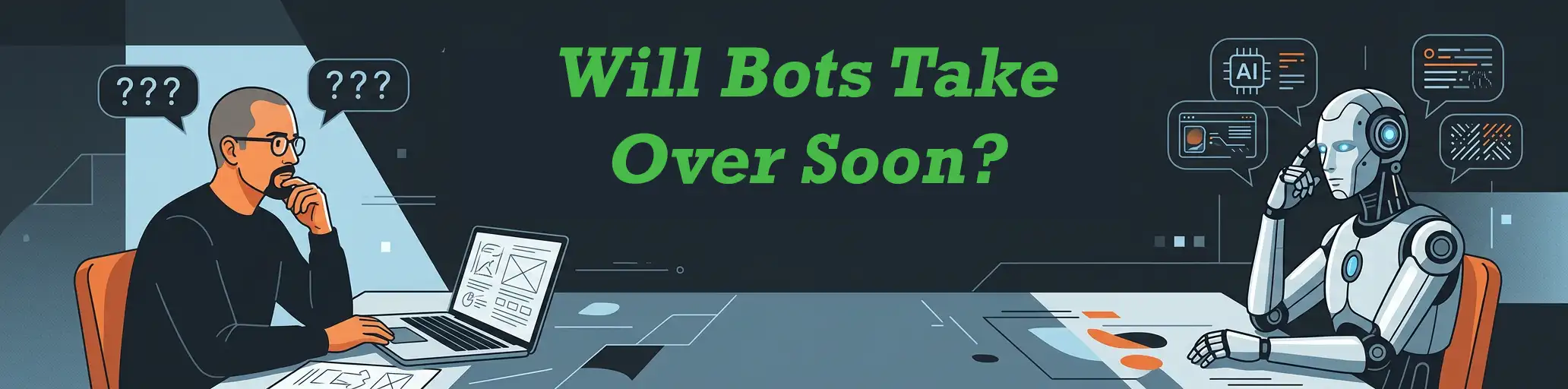
An Honest Take After 25 Years in the Business
Lately my news feed is full of headlines saying web developers and graphic designers have a year or two left before AI takes over. I've been building websites and designing print pieces since I founded I Design in 2001. In that time I've watched Flash come and go, seen templates and DIY site builders arrive, and heard "designers are finished" more times than I can count.
This time the technology really is more capable, so it deserves an honest look rather than a defensive one. What can AI actually do right now? What can't it do? And how long before it doesn't need people like me at all?
What AI can actually do today
Credit where it's due: AI tools are impressive. Today's AI website builders can generate a full layout, write the copy, pick fonts and colors, and publish a basic site in minutes. Business owners are using them. Research commissioned by Bluehost found that 53% of surveyed business owners had adopted AI website builders rather than hiring a developer. Designers have noticed. A 2026 study by the hosting company 20i found that about three out of four web design professionals now see AI as the biggest threat to their business.
Print is changing too. AI can produce a polished poster concept, an illustration, or a brochure layout in seconds.
I use AI in my own work, for first drafts, code snippets, and exploring ideas quickly. Pretending these tools don't work would be foolish. For a simple one-page site or a quick social graphic, AI is often good enough.
But "good enough to look at" and "done right" are two very different things.
The gap between looking good and being right
Websites
A generated homepage is not the same as a website a business can rely on. Most of what keeps a professional site working happens behind the scenes:
- Hosting, backups, and security updates
- Contact forms that actually deliver to the right inbox
- Search engine setup, page structure, and indexing
- Accessibility for visitors with disabilities
- Integrations such as online stores, booking systems, and content management
- Moving an existing site without losing years of search rankings
A big part of my week isn't design at all. It's cleaning up a hacked site, responding to a security notice, fixing a plugin conflict after an update, or working out why a page dropped out of Google. An AI builder can produce a site. It doesn't take the 9 p.m. phone call when that site goes down the night before a launch.
Print
Print is less forgiving than the web. A website mistake can be fixed in five minutes. A print mistake gets repeated across 5,000 copies.
An image that looks sharp on a laptop can turn soft and pixelated when printed at full size. A print-ready file needs the right resolution at its finished size, bleed beyond the trim line, safe margins, the correct color mode for the press, embedded fonts, accurate fold and panel sizes, and, for packaging, a precise die line. Right now I'm preparing files for a die-cut box that will be printed overseas.
Printers are noticing the problem. Esko, a major supplier of prepress software, reports that files built with AI design tools often arrive at prepress looking finished but not technically ready for production. Generated artwork is still known to misspell words and struggle to reproduce exact brand fonts.
Someone still has to ask, check, and answer for it
So yes, a person still has to write the prompts, review the results, and catch the errors. That's true today. But I think the bigger point is what comes before the prompt.
Most clients don't arrive knowing what they need. A law firm says it wants "a new website." What it actually needs is to look credible to a nervous person searching for a lawyer at midnight, rank for the right practice areas, and stay compliant with bar advertising rules. Working that out is a conversation, not a prompt.
Then there's accountability. When something goes wrong, a business needs someone who knows its history, understands what was built and why, and knows how to make it right.
To be fair to the other side, AI is getting better at checking its own work, and prompting will keep getting easier. That's exactly why I don't think the lasting value is in being a "prompt operator." It's in judgment, taste, and responsibility.
So how long until AI doesn't need humans?
Nobody knows, and anyone giving you a confident date is guessing. Here is my honest view.
The low end is already automated. If someone wants a $50 website, AI will build it, and that's fine. Those clients were never going to hire a studio.
Production work will keep shrinking. Over the next few years I expect AI to handle more of the mechanical parts of the job: first layouts, code, resizing, variations, and maybe a good share of prepress checking. Designers who refuse to use these tools will be slower and more expensive.
Judgment and accountability are a different problem. Getting AI to produce a beautiful design is close to solved for some kinds of work. Getting AI to know which design is right for your business, your audience, and your budget, and to stand behind that choice, is much harder. I don't see a business owner handing their brand to a machine with no person responsible any time soon.
There's also a quieter issue. AI learns from what already exists, so it tends to produce the average of what's popular. That's why so much AI-generated design already has a recognizable, generic look. Trends are easy to imitate. Design that lasts, and that's built around who you actually are, is not.
Milton Glaser, the designer behind the I ♥ NY logo, put it better than I can:
"If you're more serious about it, you have to be more concerned about durability and ideas that go beyond the moment, so I think the best designers around are always designers that have had a kind of broader look and don't change with the prevailing wind."
That has been my guiding principle since 2001, and it's the best answer I know to the AI question. A tool trained on what's popular will always follow the prevailing wind. A good designer's job is to see past it.
What this means for your business
- Need something simple and fast? An AI builder may honestly be fine. Use it.
- Does your site bring in leads, take payments, or hold client information? You want a person who is accountable for it.
- Sending AI artwork to a printer? Have someone check resolution, bleed, color, and spelling first. Reprints cost far more than a review.
- The best results come from both. A designer who uses AI well will get you better work, faster, than either one alone.
The tools have changed many times since 2001. The job hasn't: make things that work, communicate clearly, and last. If you're weighing an AI tool against a professional for your next website or print project, I'm happy to give you an honest opinion on which one makes sense, even if the answer is "you don't need me for this one."
— Matt King, I Design LLC